Medial Epicondylitis (Golfer’s Elbow): Diagnosis and Surgery
Medial epicondylitis (or “golfer’s elbow”) is a medial elbow tendinitis that causes severe chronic pain. When medical treatment fails, surgery is often the best solution to improve the pain caused by this tendinitis.

Diagnosis of medial epicondylitis (golfer’s elbow)
What is medial epicondylitis (or “Golf Elbow”)?
Medial epicondylitis is an inflammation of the tendons located on the medial, or inner, side of the elbow, attached to the epitrochlea (the medial or inner bony prominence of the humerus). Medial epicondylitis is the equivalent of lateral epicondylitis, but on the opposite side of the elbow, on the little finger side.
Medial epicondylitis may be occasional or chronic. This elbow tendinitis often causes chronic pain that can be highly disabling in daily life as well as during professional and sports activities.
This condition particularly affects athletes who overuse their upper limbs. It commonly affects golfers, which is why the condition is referred to as “golfer’s elbow” in English. It may also affect gymnasts and people practicing fitness training or weightlifting.
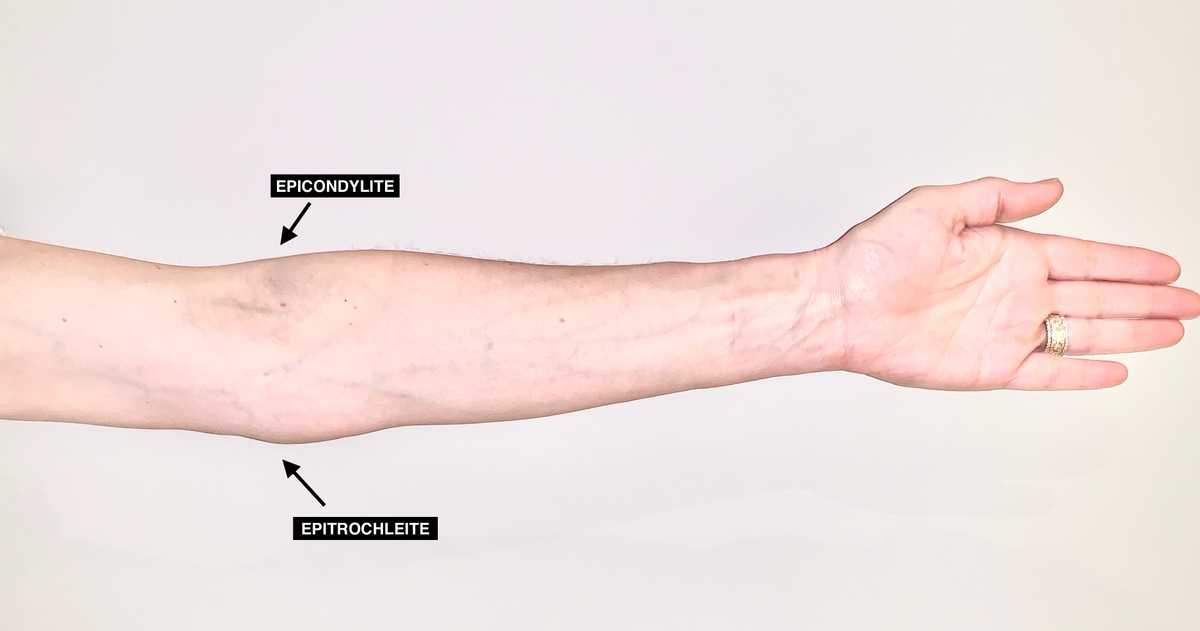
However, this elbow tendinitis can affect all types of people. A simple injury occurring during daily activities may also lead to medial epicondylitis. It may also result from repetitive strain on the elbow over long periods, especially in certain professional activities.
Symptoms of medial epicondylitis
This elbow tendinitis is a condition that may cause disabling pain during daily and sports-related activities. The pain may persist for several months or even several years.
Without treatment, medial epicondylitis may force patients to permanently stop sports activities or change their professional duties.
How is medial epicondylitis diagnosed?
The diagnosis of this elbow tendinitis is mainly based on a clinical examination. The typical pain of medial epicondylitis can be reproduced by applying pressure to the tendon insertion on the medial side of the elbow and through specific examination maneuvers.
If there is doubt regarding an early tendon rupture or associated lesions, an X-ray or MRI scan may be requested.
Irritation or compression of the ulnar nerve (also called the cubital nerve) may be associated with medial epicondylitis, causing sensory disturbances and radiating pain toward the hand. An electromyogram (EMG) may also be requested.
Medical treatment for medial epicondylitis
Treatment for elbow tendinitis is initially conservative. It involves stopping the activities responsible for the pain, combined with painkillers and anti-inflammatory medication.
This treatment is complemented by specific physical therapy, including deep transverse friction massage techniques, which are often very helpful, sometimes combined with extracorporeal shockwave therapy sessions. One or more corticosteroid injections may also be proposed.
Medical treatment for medial epicondylitis is often long and challenging. Pain relief is frequently insufficient. Surgical treatment should then be considered.
Surgical treatment for medial elbow tendinitis
Summary: Surgical treatment for medial epicondylitis
- Procedure duration: Outpatient surgery.
- Anesthesia: Regional anesthesia, only the arm is numbed.
- Immobilization: Arm sling for 8 to 10 days.
When should surgery be considered for medial epicondylitis?
Surgery is considered when medical treatment fails.
The procedure is decided after discussion with the patient when medical treatment has not been sufficiently effective after several months, with persistent pain and functional impairment.
Procedure overview
The operation is performed under regional anesthesia (only the arm is numbed). A tourniquet is placed at the root of the limb to prevent bleeding.
The procedure first consists of releasing the damaged tendons at their bony insertion in order to reduce tension. It then involves replacing the most damaged fibers with a flap of healthy nearby tendon tissue.
A 4 to 5 cm incision is made on the side of the elbow. The tendons are released by selective sectioning of their aponeurosis and at their bony insertion. Degenerated bone and tendon tissue are removed. If necessary, the adjacent ulnar nerve will be released. The resected tendon segment is then replaced with a tendon flap (meaning a portion of a healthy nearby tendon).
A PRP injection (growth factors taken from the patient’s own blood) is often performed at the end of the procedure. This PRP injection helps enhance tendon healing.
The skin is closed with an intradermal running suture in order to reduce scar visibility.
Recovery after elbow surgery
An arm sling immobilization must be maintained for about ten days.
Physical therapy should begin two weeks after surgery.
In general, returning to sports activities involving the operated arm should wait at least 2 months, while returning to office work is usually possible after a few weeks.
Results of surgical treatment for medial elbow tendinitis
Surgery is often the most effective treatment for improving symptoms and reducing pain caused by medial epicondylitis that is resistant to medical treatment.
Functional outcomes are generally very satisfactory. However, improvement is not always complete. Some pain or moderate functional discomfort may occasionally persist.
Possible complications after surgical treatment for medial epicondylitis
- The main complication is the persistence of pain or functional discomfort.
- The risk of infection is rare, but always possible, and may require antibiotic treatment or revision surgery.
- Nerve or tendon injury is also always possible.
- Elbow stiffness, with swelling and pain, may persist for several months.
- Complex regional pain syndrome, with stiffness, swelling, and pain that may evolve over several months. Unfortunately, this condition cannot be predicted before surgery. Its treatment is difficult and often leaves residual functional limitations and loss of mobility.
- Stopping sports activities, or even changing professional duties, may become necessary despite surgery. In such cases, the cause is not the surgical procedure itself, but the initial tendon damage.