Clavicle fracture: Diagnosis & surgical treatment
A clavicle fracture often occurs during a sporting activity (such as skiing, cycling, judo) or an accident, particularly on public roads (bike, scooter, motorcycle saccidents).

Contents :
The treatment of a clavicle fracture is often mistakenly considered purely conservative, relying only on sling immobilization or clavicle braces. However, some fracture types require surgical management to achieve optimal functional outcomes.
Indeed, pain or permanent loss of shoulder mobility may result from poor healing with clavicle deformity, lack of bone union, or injury to nearby vessels and nerves.
Diagnosis of clavicle fracture
Diagnosis of a clavicle fracture is generally straightforward. After trauma, patients present with pain, bruising, and sometimes visible deformity of the clavicle, making arm use difficult.
The most common causes include falls during sports activities (skiing, judo) and road traffic accidents. Clavicle fractures are also frequent in scooter and motorcycle riders, and increasingly in cyclists and e-scooter users.
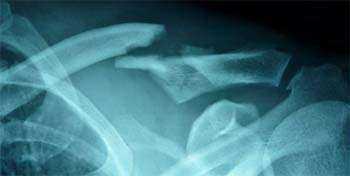
An X-ray is usually sufficient to confirm the diagnosis and assess severity. It helps determine fracture location, displacement, and the number and position of bone fragments.
In some cases, a CT scan with 3D reconstruction is useful. A Doppler ultrasound may be performed if vascular injury is suspected. An electromyogram (EMG) may be required if nerve injury (brachial plexus) is suspected.
Sling or clavicle brace treatment
Why use a sling or clavicle brace?
This non-surgical treatment aims to immobilize the clavicle, preventing displacement, reducing pain, and allowing bone healing.
Early movement of the arm and shoulder during the first weeks may prevent proper healing, leading to displacement or nonunion, and resulting in chronic pain and permanent shoulder limitation.
Immobilization is achieved using a sling or clavicle braces for 3 to 6 weeks depending on fracture type and location.
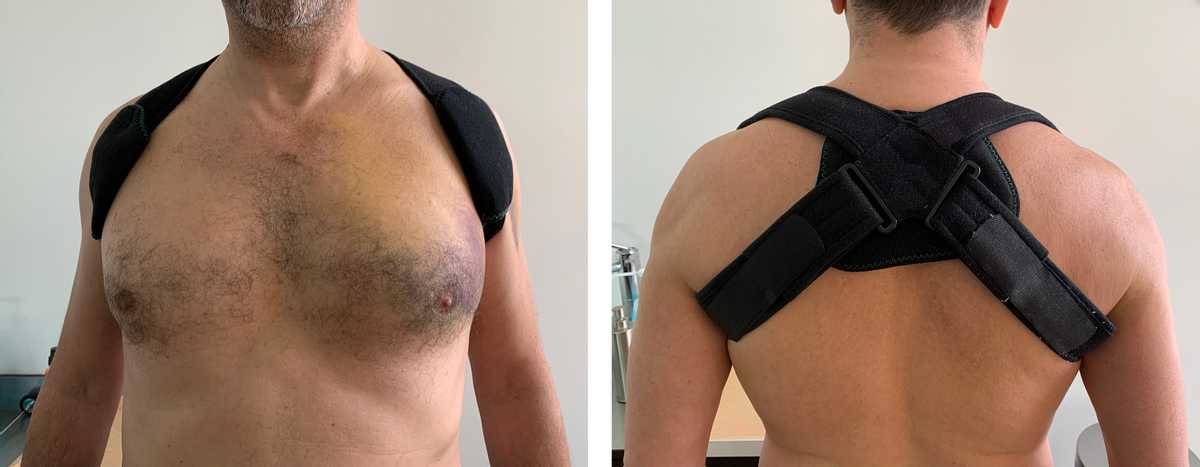
Immobilization using clavicle braces
Indications
Simple immobilization is appropriate for non-displaced fractures without significant shortening or risk to surrounding vessels/nerves.
In more complex fractures, immobilization alone may be insufficient and can lead to malunion or nonunion, sometimes requiring surgery.
Duration of immobilization
Immobilization typically lasts 3 to 6 weeks.
Pain decreases at rest relatively quickly but may persist during shoulder movement.
Return to sport is usually allowed between 6 weeks and 3 months, depending on healing and sport type.
Surgery for clavicle fracture
Summary
- Anesthesia: General
- Hospital stay: 1 night
- Immobilization: Sling for 4 to 6 weeks
When is surgery necessary?
Surgery is less frequently required than conservative treatment but remains underused and sometimes overlooked.
Some patients develop nonunion or malunion that could have been prevented with early surgery.
Surgical indications:
- Displaced fractures, especially with skin tenting, nerve or vessel compression, or significant shortening.
- Fractures associated with major trauma, such as skiing or road accidents (motorcycle, scooter, bicycle, e-scooter).
- In high-level athletes, surgery is often recommended to ensure faster and optimal recovery.
Principle of surgery
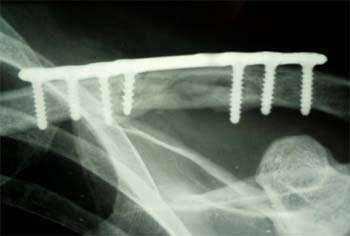
The goal is to realign bone fragments and stabilize them using an anatomical plate and screws.
Results and postoperative course
Surgery allows immediate anatomical restoration and rapid pain relief.
A scar along the clavicle is required and may widen over time, especially in thin patients.
Plate removal is usually performed 1 to 1.5 years later.
Lateral clavicle fractures
Fractures of the lateral (outer) clavicle often require surgery due to high risk of nonunion.
Treatment may involve pinning or ligament augmentation instead of plating.
In borderline cases, the treatment choice is discussed during consultation.
Urgent clavicle fracture care:
Not all fractures require emergency surgery, but early management is sometimes recommended to avoid complications.
If significant displacement or risk of poor healing is present, early surgical management improves recovery.
For fresh fractures, you may contact Dr. Roure’s team for prompt evaluation.
Clavicle nonunion (pseudarthrosis)
Nonunion refers to the absence of bone healing after fracture. It is not uncommon in clavicle fractures, especially when displacement is significant or immobilization insufficient.
Surgery is usually indicated as nonunion is often poorly tolerated.
Treatment involves plating and bone grafting, often harvested from the iliac crest.
Malunion of the clavicle
Malunion refers to healing in a poor position. It may result in shortening, bone prominence, or angular deformity.
In cases of functional impairment, surgery may be required.
The procedure involves re-fracturing the clavicle, correcting alignment, and fixing it with a plate, often with bone grafting.
Possible risks after clavicle fracture surgery
Complications are rare but possible:
- Recovery may be long and requires patient compliance with immobilization and rehabilitation.
- Despite good alignment, nonunion may still occur, possibly requiring further surgery.
- Injury to nerves, vessels, or even the lung is extremely rare but possible.
- Skin necrosis is uncommon but may require prolonged care.
- Pain may persist for several weeks.
- Complex regional pain syndrome may occur, causing prolonged pain and stiffness, sometimes lasting years.
- Infection risk is rare but may require treatment or reoperation.
- Hematoma may occur and require drainage.
- Inflammatory scarring may develop depending on skin type.
- Temporary loss of sensation around the scar is common.
- Shoulder stiffness may persist for several months in some patients.