Subacromial impingement: Diagnosis & Acromioplasty
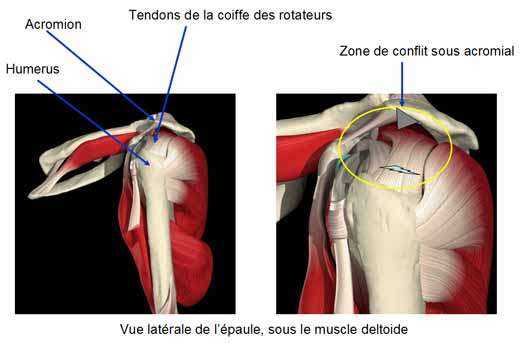
Subacromial impingement is an inflammation or superficial tear of the rotator cuff tendons caused by friction between these tendons under the acromion during everyday activities. Acromioplasty is a surgical procedure to treat subacromial impingement by shaving down the overly prominent and aggressive bone.

Contents :
What is subacromial impingement?
Subacromial impingement syndrome corresponds to abnormal friction between the inferior and anterior edge of the acromion and the rotator cuff tendons, which attach to the upper part of the humerus. This conflict leads to progressive wear of the rotator cuff tendons, which may eventually result in tendon rupture.
This friction causes pain when lifting the arm above shoulder level. These symptoms can make repetitive overhead work difficult as well as sleeping on the affected side.
If left untreated, subacromial impingement gradually worsens, with more intense and frequent pain. It can lead to rotator cuff tendinopathy, and eventually rotator cuff tendon rupture.
Diagnosis of subacromial impingement
Diagnosis is made during a clinical examination by the physician, who performs specific shoulder maneuvers and questions the patient. Several tests (Yocum, Neer, Jobe) are used to reproduce pain and confirm the diagnosis.
Diagnosis is usually completed with imaging studies: X-rays, CT arthrogram, MRI, or ultrasound.
Causes of subacromial impingement
Several factors may be responsible for subacromial impingement and shoulder pain:
- Repetitive movements due to occupational activities (musculoskeletal disorders), repetitive work involving shoulder motion, or DIY activities).
- Repetitive sports-related shoulder movements.
- Trauma leading to partial tendon tears.
- Anatomical narrowing of the subacromial space due to a curved acromion or bone spurs (osteophytes) caused by osteoarthritis.
Treatment of subacromial impingement
The goal of treatment is to eliminate abnormal friction and tendon inflammation under the acromion. Treatment may be conservative (medical) or surgical (arthroscopic acromioplasty).
Medical treatment
Initial treatment is conservative and is usually sufficient in early-stage cases.
It consists of rest (avoiding painful movements) and physiotherapy. Rehabilitation aims to increase subacromial space by strengthening specific muscles and may last several months. Daily exercises prescribed by the physiotherapist are essential.
Corticosteroid injections may be performed in the joint.
Extracorporeal shockwave therapy may also be proposed.
Surgical treatment: arthroscopic acromioplasty
Acromioplasty is indicated when conservative treatment fails.
It is a minimally invasive procedure that removes mechanical impingement by smoothing the underside of the acromion, washing the joint, and removing inflamed tissue, especially bursitis.
Acromioplasty is now almost always performed arthroscopically rather than open surgery.
Arthroscopic acromioplasty
Summary
- Duration: approximately 1 hour
- Hospital stay: outpatient or 1 night
- Anesthesia: general, sometimes regional depending on the patient
- Immobilization: sling or arm at side for 2 weeks
- Work leave: from a few days to several months depending on occupation
- Return to sports: after 45 days
Surgical procedure
The procedure begins with 2 to 3 small incisions (about 1 cm). These allow insertion of an arthroscopic system (camera and miniaturized instruments).
The joint is explored and washed.
Inflamed tissue and bursitis are then removed. Using a burr, the surgeon removes bone spurs and reduces the thickness of the acromion. This creates more space, reducing tendon friction and allowing the rotator cuff tendons to heal over several months.
The incisions are closed with absorbable sutures.
Special case: long head of the biceps tendon
If the long head of the biceps tendon is damaged and contributes to pain, it may be cut during surgery. This procedure is called a tenotomy.
The biceps muscle may appear slightly lower, but this has no functional consequence for strength or daily activities.
Postoperative care after acromioplasty
Dressings should be changed every two days, ideally by a nurse.
A sling or arm-at-side immobilization is recommended for 2 weeks before resuming daily activities.
Rehabilitation
After 3 weeks, physiotherapy begins with a physical therapist.
Three sessions per week are usually recommended for a duration of 1 to 3 months.
Return to work and sports
Sedentary work may resume within a few days, while physically demanding jobs may require several months.
Sports involving the shoulder usually resume after at least 45 days, depending on initial lesions. Driving may resume after at least 8 days.
Pain outcome
Pain may persist for several months after surgery. Improvement is gradual, typically within 3 to 6 months, as tendon and bone healing occurs.
In most cases, pain becomes significantly reduced or disappears. However, persistent symptoms may remain depending on initial severity and delayed treatment.
Possible complications
Although arthroscopy is minimally invasive, complications may still occur:
- Risk of complex regional pain syndrome (rare)
- Shoulder stiffness, sometimes long-lasting
- Infection risks (rare): septic arthritis, hemarthrosis, inflammatory healing issues
- Rare nerve complications
- Breakage of arthroscopic instruments requiring additional surgery
Further reading:
> Subacromial impingement explained (interview with Dr Roure on Santé Magazine)