Ulnar nerve entrapment: Diagnosis and surgery
Ulnar nerve compression syndrome leads to loss of sensation in the last two fingers, weakness in the hand, and even pain. If performed early, decompression surgery can prevent the condition from progressing to irreversible muscle paralysis and loss of sensation in the fingers.

Contents :
Cubital nerve compression syndrome
What is the cubital nerve?
The cubital nerve (also called the ulnar nerve) travels along the inner side of the arm, from the base of the neck toward the elbow.
Its pathway runs behind the medial epicondyle, the bony prominence located on the inner side of the elbow, before following the ulna (formerly called the cubitus), one of the two forearm bones along with the radius, toward the ring finger and little finger, meaning the last two fingers of the hand.
It supplies several muscles of the forearm before continuing into the hand, where it contributes to the innervation of the hand muscles and transmits tactile sensation from these two fingers.
The ulnar nerve therefore has two main functions:
- It controls movement, particularly flexion and adduction (side bending) of the wrist and fingers.
- It allows the reception and transmission of sensory information from the hand.
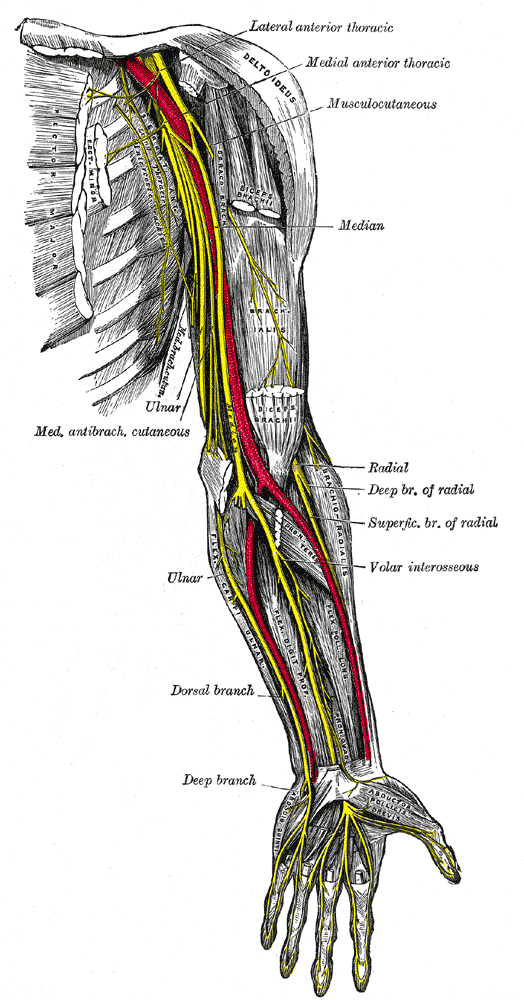
What is cubital tunnel syndrome or ulnar nerve compression syndrome?
Cubital tunnel syndrome refers to compression of the cubital nerve (shown in yellow on the anatomical diagram opposite) at the elbow. This compression progressively causes loss of sensation in the last two fingers of the hand: the little finger and half of the ring finger.
This syndrome is associated with loss of strength and endurance in the hand, cramps, and may also lead to muscle wasting in the hand.
Unlike the median nerve in carpal tunnel syndrome, the most common site of cubital nerve compression is on the inner side of the elbow. Less common and less well known than carpal tunnel syndrome, cubital nerve syndrome is often diagnosed late.
This condition progressively evolves toward irreversible paralysis of the hand muscles and permanent loss of sensation in the ring finger and little finger. Surgical decompression must therefore be performed in time.
Cubital nerve compression syndrome may be related to musculoskeletal disorders (MSDs).
Diagnosis of ulnar nerve compression
What are the clinical signs of ulnar nerve compression?
- Paresthesia (tingling), loss of sensation in the little finger, ring finger, and along the inner edge of the hand.
- Reduced grip strength, wasting of the hand muscles.
- Pain radiating along the inner side of the forearm, at the elbow, and sometimes extending up the arm toward the shoulder and neck. Symptoms may appear gradually or after trauma or unusual movements (sports, moving house, etc.).
Clinical examination
The diagnosis of ulnar nerve compression is primarily clinical. The main symptoms of this syndrome are identified: sensory loss, reduced strength, and pain. Tenderness on pressure over the nerve at the elbow may also be present.
Instability of the cubital nerve during elbow flexion movements may also be detected, presenting as a snapping sensation caused by the nerve rolling over the bony prominence of the epitrochlea. A complementary dynamic ultrasound examination may then be requested.
An electromyogram (EMG) is systematically requested. This examination is performed by a neurologist and helps diagnose possible nerve compression. However, this test is less reliable for the ulnar nerve than for carpal tunnel syndrome. Indeed, the compression may be dynamic (occurring during movement), whereas the examination is performed at rest. The electromyogram is therefore only an aid to diagnosis.
Other imaging examinations (X-rays, ultrasound scans, MRI) may also sometimes be necessary.
Conservative or surgical treatment?
In cases of early or mildly symptomatic compression, treatment is initially conservative. It involves changing the movements or activities that may be responsible for the compression. Conservative treatment may also include physical therapy or the use of a custom orthosis.
Anti-inflammatory medication may also be prescribed for a few days.
In cases of persistent symptoms, major functional impairment, persistent finger hypoesthesia, or significant compression shown on the electromyogram, surgical decompression of the ulnar nerve should be considered promptly.
Cubital nerve decompression surgery
The principle of cubital nerve decompression surgery is to create more space around the nerve at the elbow. This procedure is also referred to as “releasing” the cubital (or ulnar) nerve.
The operation is performed under regional anesthesia, meaning only the arm is numbed. A tourniquet placed at the top of the arm limits bleeding.
In straightforward cases, a simple release of the nerve within its groove is performed.
If the cubital nerve is unstable and moves over the epitrochlea…
The epitrochlea corresponds to the inner bony prominence of the elbow, acting as the anterior pulley over which the nerve glides during elbow flexion.
If the nerve tends to move over the epitrochlea during elbow flexion, Dr. Philippe Roure performs an epitrochlectomy. This surgical procedure involves removing this bony prominence in order to eliminate the conflict and create more space for the nerve during elbow flexion.
Surgery summary:
- Procedure duration: Outpatient surgery.
- Anesthesia: Regional anesthesia, only the arm is anesthetized.
- Immobilization: Arm sling for 10 days.
Postoperative recovery
Recovery after cubital nerve decompression surgery
After cubital nerve surgery, a resting arm sling should be worn for approximately ten days.
For two weeks, the dressings covering the scar should be changed every two days.
A hematoma is frequently present during the first few weeks. It then gradually disappears completely.
Results and rehabilitation
The various symptoms caused by nerve compression generally disappear after a few days. In some patients, these symptoms may not improve for several months.
Physical therapy may be necessary 3 weeks after surgery in order to restore elbow range of motion.
Pressure on the inner side of the elbow over the scar may remain painful for several months.
In general, functional recovery is complete if the procedure is performed early, and the patient can return to all sports and physical activities.
Possible complications:
Complications after cubital nerve decompression surgery are rare. Nevertheless, the risks inherent to any surgical procedure must always be considered.
- The risk of postoperative infection is low. In general, it is easily managed when the diagnosis and treatment are performed early.
- Significant hematoma that may require secondary surgical drainage.
- The risk of nerve injury is exceptional.
- Incomplete recovery is possible. It is more common when surgery is performed too late.
- Recurrence is uncommon but always possible.
- The risk of complex regional pain syndrome (CRPS) affecting the hand and shoulder is unpredictable.