Tendinopathy of the rotator cuff
This is a degenerative or traumatic lesion at the rotator cuff tendons which is a frequent source of pain and functional disability, particularly after age 40.
Contents:
What is rotator cuff tendinopathy?
The rotator cuff tendons
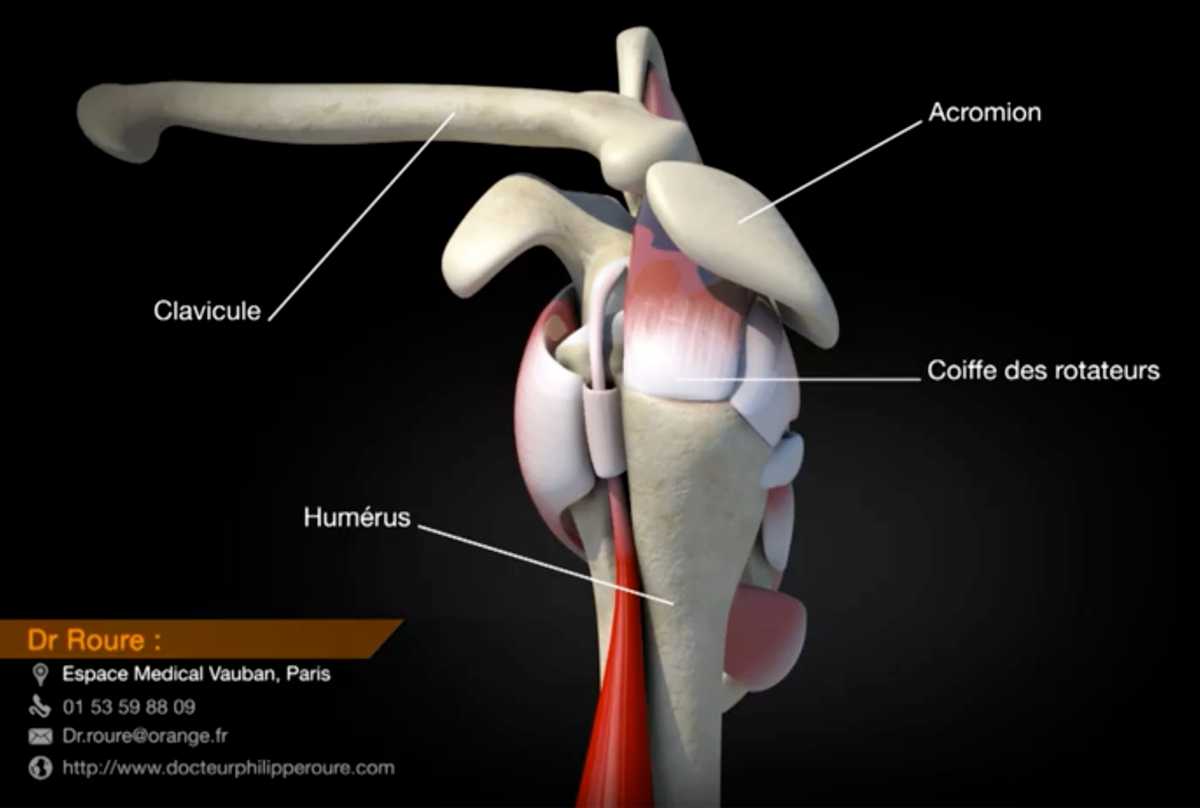
The rotator cuff tendons are the terminal portions of the muscles surrounding the head of the humerus, attaching on one side to the scapula and on the other to the upper end of the humerus. These tendons allow arm elevation and shoulder rotation movements.
These tendons are particularly exposed because they are “sandwiched” between the head of the humerus and the acromion, a bony projection of the scapula located at the top of the shoulder.
Different types of rotator cuff tendon injuries
Several types of rotator cuff tendon conditions can be distinguished:
- Subacromial impingement corresponds to wear and inflammation without a full tendon tear. It causes rotator cuff tendinitis, especially of the supraspinatus tendon.
- Calcific tendinopathy of the shoulder, in which calcium deposits form within inflamed rotator cuff tendons. This condition often causes significant pain.
- Rotator cuff tear corresponds to the advanced stage of the condition. The size and severity of the tear may vary. In addition to pain, it can eventually lead to severe loss of arm elevation and destructive shoulder arthritis (called omarthrosis).
Causes of rotator cuff tendinopathy
Rotator cuff tendons are subjected to repeated friction between the humerus and the acromion, which accumulates over time and is worsened by trauma or repetitive movements.
Rotator cuff tendinitis is therefore commonly seen in swimmers, tennis players, throwers, and athletes involved in weight training, boxing, fitness, and more recently CrossFit.
Pain is located on the side of the shoulder and may radiate into the arm and up toward the neck.
DIY enthusiasts and gardeners, as well as workers performing repetitive overhead activities, are also particularly exposed to rotator cuff tendinopathy.
Tendinitis may also be promoted by the presence of a bony spur under the acromion. The acromion becomes more aggressive and progressively damages the tendons. This is known as subacromial impingement.
This process, combined with age-related tendon thinning, may lead to tendinitis and eventually partial or complete rotator cuff tears.
Calcifications may also form due to chronic inflammation within the tendons, increasing friction and pain.
Medical treatment
Diagnosis of rotator cuff tendinitis
Subacromial impingement is diagnosed during a consultation with a specialist. In addition to history-taking, the physician performs several specific shoulder tests.
These include the Yocum, Neer, and Jobe tests. If these maneuvers reproduce the pain, rotator cuff tendinopathy is likely.
Additional imaging
These lesions are generally not visible on standard X-rays. An arthro-CT scan, MRI, or ultrasound is often required to clarify the nature of the rotator cuff injury.
This imaging assessment is essential to determine the most appropriate treatment (medical or surgical) for the patient.
Rest and rehabilitation
Medical treatment is usually sufficient for early-stage rotator cuff tendinopathy.
It consists of rest combined with physiotherapy. Painful movements should be avoided. Rehabilitation helps strengthen the muscles that depress and recentre the humeral head.
This may be combined with one or more intra-articular corticosteroid injections.
Surgical treatment of rotator cuff tendinopathy
Surgery may be considered when medical treatment fails.
The type of procedure depends on the patient’s tendon condition.
Case 1: Superficial tendon damage with subacromial impingement
If an overly aggressive acromion is responsible for the condition, an acromioplasty may be indicated.
This procedure removes mechanical friction areas, combined with lavage and removal of inflamed tissue.
Acromioplasty is now almost always performed arthroscopically rather than through open surgery.
> Learn more about subacromial impingement
Case 2: Severe tendon damage
If the tendons are significantly damaged (more than 50%), surgical tendon repair may be required.
The degenerative portion of the tendon is removed at its insertion on the bone, and the healthy tendon is reattached to the bone using one or more anchors. This is similar to the procedure used for a complete rotator cuff tear.
This surgery is performed arthroscopically, reducing post-operative pain and facilitating rehabilitation.
> Learn more about rotator cuff tears