Acromioclavicular dislocation - Clavicle dislocation
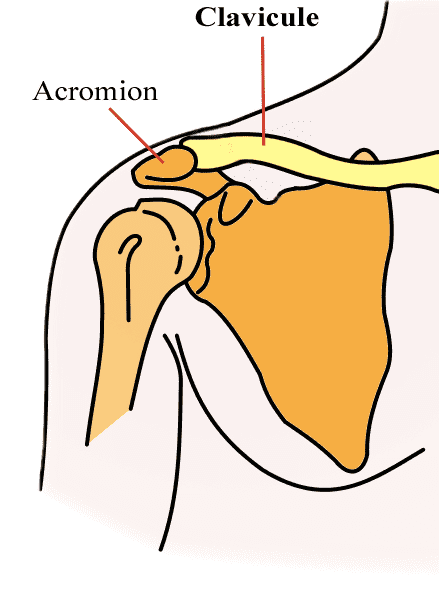
Acromioclavicular dislocation is a dislocation of the lateral end of the clavicle, at the joint with the acromion. A clavicle dislocation often occurs after a fall onto the shoulder and results in a deformity with a bump on the top of the shoulder. Depending on the severity of the dislocation, treatment may be medical or surgical.

Contents :
Diagnosis of acromioclavicular dislocation
Acromioclavicular dislocation refers to a dislocation of the lateral end of the clavicle, at the joint with the acromion. A dislocation is a more severe injury than a simple sprain.
In this condition, several stabilizing ligaments are torn, resulting in a visible shoulder deformity with prominence of the outer end of the clavicle, either constant or accentuated during shoulder movement.
Acromioclavicular dislocation does not usually prevent normal use of the arm and hand in daily life. However, it can be a significant handicap for activities requiring the arm above shoulder level, especially sports.
Causes of clavicle dislocation
Acromioclavicular dislocation is caused by trauma, usually a fall onto the shoulder. It most often occurs during road accidents (two-wheelers, scooters, etc.) or sports injuries (skiing, cycling, judo, horse riding, etc.).
Clinical examination
Diagnosis is mainly clinical. The physician may observe a deformity of the top of the shoulder due to upward displacement of the clavicle, which may become more pronounced with certain movements.
X-rays and sometimes MRI are performed to confirm the diagnosis and assess the severity grade, which guides treatment.
How to treat a clavicle dislocation
Treatment depends on the severity of the dislocation, which is classified into different grades.
- Grades 1 and 2 usually do not cause visible deformity. Some ligaments are torn, but others remain intact, maintaining joint stability.
- Grades 3 and 4 involve more extensive ligament damage, leading to more or less significant upward displacement of the clavicle.
For grade 1 and 2 injuries:
Surgery is not indicated when there is no displacement (grades I and II).
Treatment consists of arm immobilization with a sling for 2 to 3 weeks, often combined with anti-inflammatory medication.
Pain usually improves, although discomfort during overhead movements may persist for several months.
For grade 3 or 4 injuries:
Surgery is generally indicated when clavicle displacement is present (grades III or IV).
It is particularly recommended for active or athletic patients who wish to fully recover shoulder function, especially for sports or overhead activities.
Without surgery, the deformity is permanent and may worsen during physical effort. Function below shoulder level is usually preserved, but limitations vary between patients.
Surgical treatment of acromioclavicular dislocation
Summary: Surgery for acromioclavicular dislocation
- Anesthesia: General
- Hospital stay: 1 night
- Immobilization: Sling for 4 to 6 weeks, with free hand and elbow
Choice of surgical technique
Several surgical techniques exist.
Dr. Roure performs clavicle stabilization using a synthetic ligament reconstruction, which he considers the most reliable technique based on experience, particularly for high-level athletes.
This technique allows patients to return to full sports and physical activity.
Principle of the procedure
The operation involves inserting a synthetic ligament to reposition and stabilize the clavicle. It is introduced through a small incision on the top of the shoulder and fixed to the scapula using a permanent anchor.
This ligament acts as a support for the repaired natural ligaments.
If the joint end of the clavicle is damaged, a small resection may be performed during the same procedure.
This technique does not require metal pins, which would need later removal.
Postoperative care after acromioclavicular dislocation surgery
After surgery, the arm is immobilized in a sling for 4 to 6 weeks. The hand remains free and usable when the elbow is supported, allowing basic daily activities such as eating, writing, or computer use.
Pain and discomfort may persist for several months and gradually improve.
Rehabilitation and return to sport
Rehabilitation usually begins about 6 weeks after surgery.
Some light sports activities may resume earlier (around 2 weeks), such as cycling on a stationary bike, lower-body training, or abdominal exercises.
Running can generally resume after 6 weeks. Contact sports and upper-body weight training are typically resumed after 3 to 4 months.
Possible complications
Recovery can be prolonged, as with any shoulder surgery.
- A slight residual elevation of the clavicle may remain visible.
- Pain may persist for several months due to tissue healing.
- Complex regional pain syndrome may occur unpredictably, causing prolonged pain and stiffness of the shoulder and arm, sometimes lasting years.
- Joint infection is rare but possible and may require antibiotics or revision surgery.
- Hematoma may occur and occasionally require surgical evacuation.
- Inflammatory scarring may depend on skin type.
- Shoulder stiffness may develop and can take months to resolve or may persist in some cases.