Wrist fracture: diagnosis and treatment
In the simplest cases, wrist fractures are generally treated medically with immobilization. In the case of a more complex wrist fracture, the most modern surgical techniques allow for minimizing long-term effects and limiting wrist immobilization.

Table of contents :
Diagnosis of a wrist fracture
What is a wrist fracture?
The term “wrist” refers to a joint made up of several bones. Therefore, it is not technically the wrist itself that fractures, but one or more of the bones composing it.
Most commonly, the term “wrist fracture” refers to a fracture of the distal radius. This injury may also be associated with a ulna fracture.
What causes a wrist fracture?
Wrist fractures are very common injuries that can affect people of all ages. They may result from household accidents, sports injuries (skiing, cycling, rugby, horseback riding, etc.), or road accidents (motorcycle, scooter, electric scooter).
A wrist fracture usually occurs after a fall onto the hand.
In younger patients, fractures are often caused by high-energy trauma (ski accident, fall from height). In older patients, especially women with osteoporosis, the bones become fragile and may fracture after minor trauma.
How is the diagnosis made?
Following a fall or impact, the wrist may appear swollen and deformed, or simply painful.
Although pain is usually the first sign of a fracture, there is no direct relationship between the severity of the fracture and the intensity of the pain. A fall may cause severe wrist pain without an actual fracture. A simple wrist sprain may also cause significant pain.
If the wrist appears deformed after trauma, a fracture is highly suspected.
A swollen wrist with bruising or edema also suggests a fracture.
To confirm the diagnosis, an X-ray is essential. Wrist fracture diagnosis is primarily based on imaging.
A CT scan may be required for complex fractures to provide additional information.
Prognosis of a wrist fracture
The prognosis is generally favorable in simple fractures.
In cases of complex fractures, recovery may be more difficult, with residual pain and reduced mobility. Early and appropriate treatment is therefore essential.
Wrist fracture emergency:
Not all wrist fractures require emergency surgery, but in certain cases, prompt surgical management is preferable to ensure optimal healing and full recovery of mobility.
When there is major displacement, instability, or a risk of poor reduction, early surgery helps stabilize the joint and facilitates rapid mobilization.
For any recent wrist fracture, you may contact Dr. Roure’s team so that a treatment solution can be offered as quickly as possible.
Immobilization treatment for wrist fractures
Conservative or surgical treatment?
A wrist fracture may be treated conservatively with immobilization or surgically (using either an anatomical plate or pins).
The choice of treatment depends on the type of fracture and the patient profile. The objective is to select the least invasive method while ensuring optimal recovery of wrist and hand function. The goal is also to minimize immobilization time and disability.
When is immobilization recommended?
Immobilization treatment is generally proposed for non-displaced or minimally displaced fractures.
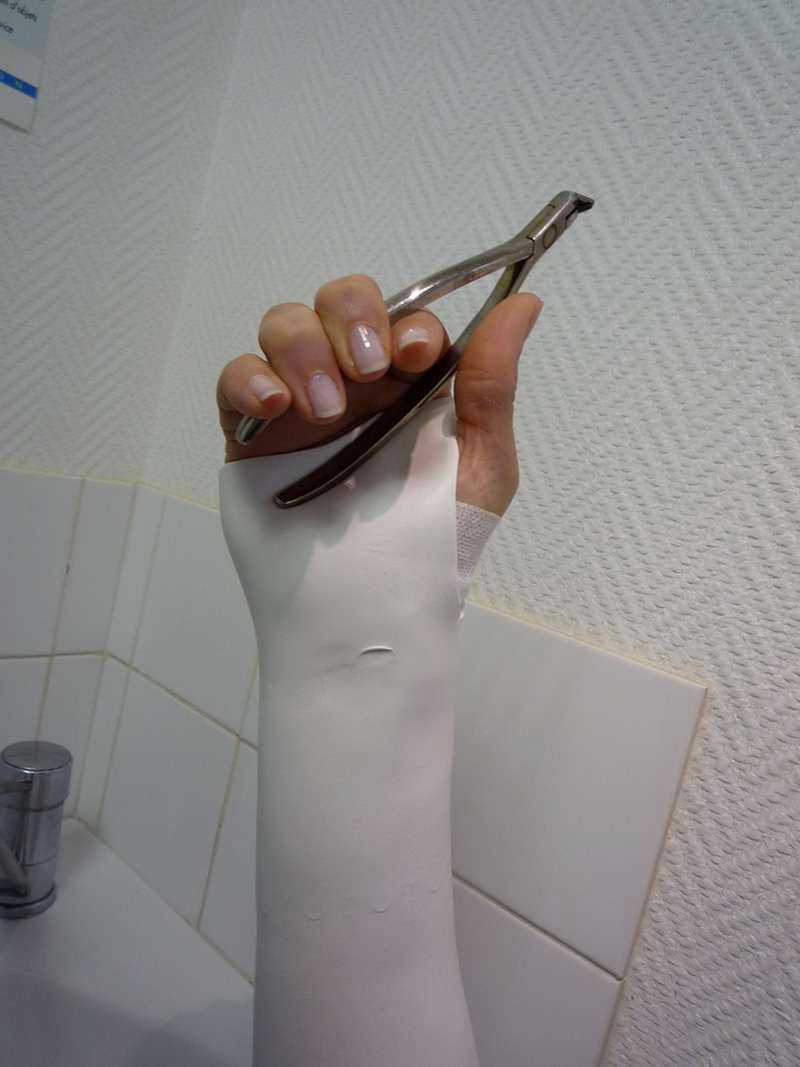
Principle of immobilization treatment
Traditional techniques involve non-removable immobilization using a cast or resin splint, which may or may not include the elbow.
Immobilization generally lasts about 6 weeks.
Clinical and radiographic follow-up is necessary to monitor for secondary displacement.
After immobilization, a rehabilitation program is often prescribed to restore full range of motion.
Advantages of custom thermoformed splints
In most cases, it is now possible to use a custom thermoformed splint.
These splints allow full finger mobility while remaining lightweight and compact.
They may also be carefully removed for hand hygiene.
Surgical treatment of wrist fractures
There are two main surgical techniques for treating wrist fractures:
- Fixation with an anatomical plate,
- Pin fixation.
The choice depends on the fracture type, patient profile, and professional or athletic demands. The objective is to achieve an optimal outcome while minimizing immobilization and disability.
Fixation with an anatomical plate is increasingly preferred for this purpose.
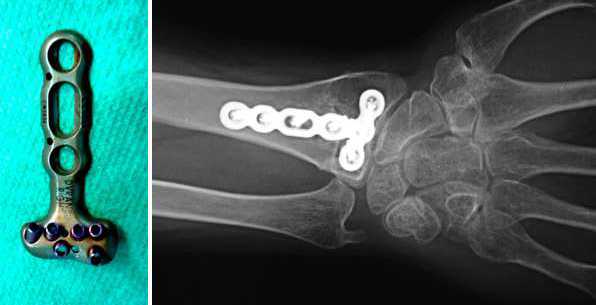
Anatomical plate fixation
In cases of a displaced or unstable distal radius fracture, the bone may be stabilized using a specially designed anatomical plate adapted to the shape of the radius. The screws lock into both the bone and the plate.
The incision is made on the front aspect of the wrist, allowing access to the radius.
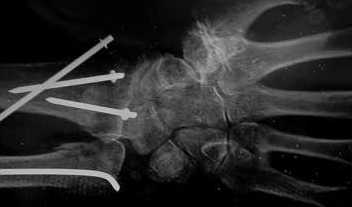
Pin fixation
Pins are metal rods measuring approximately 1 to 2 mm in diameter.
Through small skin incisions, the pins are inserted into the bone to stabilize the fracture.
At the end of the procedure, the pins are either buried under the skin or left exposed and protected with dressings.
Summary
- Hospital stay: outpatient or one overnight stay.
- Anesthesia: regional (only the arm is numbed)
- Immobilization: splint for 3 to 6 weeks
- Surgical options: anatomical plate fixation or pin fixation
Postoperative care
A thermoformed splint is generally used for 3 to 6 weeks.
The fingers and thumb remain free and can be used for daily activities.
Rehabilitation generally begins after immobilization ends.
Postoperative recovery varies depending on the surgical technique used.
After anatomical plate fixation:
A period of strict immobilization is often required for several days before switching to a removable thermoformed splint. Finger motion is allowed immediately.
Activities of daily living (except sports and heavy labor) may usually be resumed after about one week in uncomplicated cases.
This technique allows early wrist mobilization due to the rigidity of the fixation.
The plate may either remain permanently or be removed during a short procedure within the following year.
After pin fixation:
Strict immobilization is usually required for 4 to 6 weeks.
The pins are then removed either during consultation or during a short surgical procedure.
Rehabilitation begins after pin removal.
Possible complications
Complications following surgical treatment of a wrist fracture are rare but possible:
- Infection is uncommon.
- A swollen, painful, stiff hand may occur in cases of complex regional pain syndrome. This complication is unpredictable and may last several months. Residual stiffness and pain are possible.
- Tendon rupture may occur, whether or not surgery was performed, because tendons run close to the fracture site.
- The risk of nonunion is particularly rare.
- The fracture may occasionally shift secondarily.
- In some patients, recovery of mobility may be difficult and persistent pain may remain.
Clinical case: rapid return to work
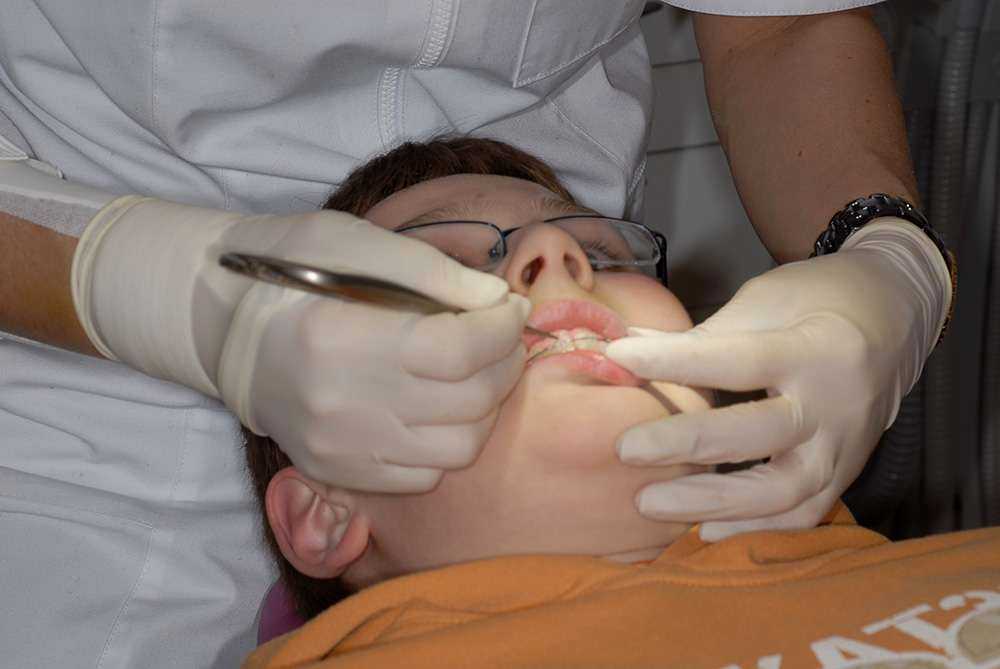
Dr. Roure notably treated a patient working as an orthodontist following a wrist fracture.
Her fracture was first stabilized using an anatomical plate. The surgery was then combined with a custom thermoformed orthosis specifically adapted for the use of dental instruments.
This allowed the patient to return to work very quickly. This technique can also be adapted to other specific professional situations, especially for patients who need a rapid return to activity.