Kienböck's disease: Diagnosis and surgery
Kienböck's disease is an avascular necrosis of the lunate bone of the wrist that leads to pain, then deformity and fragmentation of the bone. Depending on the stage of the disease, several surgical techniques are available to treat Kienböck's disease.

Diagnosis of Kienböck disease
What is Kienböck disease?
Kienböck disease is an avascular necrosis of one of the wrist bones, the lunate bone (also called the semilunar bone). Avascular necrosis means that the bone gradually dies because blood vessels no longer supply sufficient blood to the bone tissue.
This necrosis gradually leads to wrist pain, followed by deformation and fragmentation of the lunate bone. This deformation causes progressive destruction of the entire wrist, resulting in stiffness and loss of functional use.
There are no consequences of this disease outside the affected wrist; the rest of the body is unaffected.
The causes of Kienböck disease are not yet fully understood. It is a rare condition, more commonly affecting young men.
The causes are still unclear and likely multifactorial. Having a relatively longer radius compared to the ulna (also called the cubitus), sustaining a major wrist hyperextension injury, or repeated microtrauma are considered risk factors.
What are the symptoms?
The clinical signs of Kienböck disease are non-specific. Patients are usually young adults. They experience chronic wrist pain without a clear initial cause.
This pain gradually worsens. It increases when the wrist is under load and in hyperextension (for example, during push-ups).
Stiffness develops progressively, with reduced wrist flexion and extension, along with loss of strength.
Additional tests
Only additional imaging tests can confirm the diagnosis of Kienböck disease. They also help determine the stage of the disease.
- X-rays may show increased bone density of the lunate or deformation and fragmentation in advanced stages. In early stages, they are often normal or inconclusive.
- CT arthrography and MRI are the preferred exams to confirm the diagnosis and assess severity.
- A bone scan may sometimes be requested in uncertain cases.
Once diagnosed, four main stages can be defined depending on the extent of lunate involvement, ranging from simple signal changes to bone fragmentation and possible involvement of adjacent bones.
Surgical interventions for Kienböck disease
Treatment of Kienböck disease is mainly surgical. However, wrist splinting and removal of aggravating factors (sport, work activity, smoking, etc.) may be attempted in very early stages.
Objective of surgery
Without treatment, the natural progression leads to worsening destruction of the lunate and then the entire wrist. Therefore, the earlier the surgical treatment, the less invasive the procedure and the better the outcome.
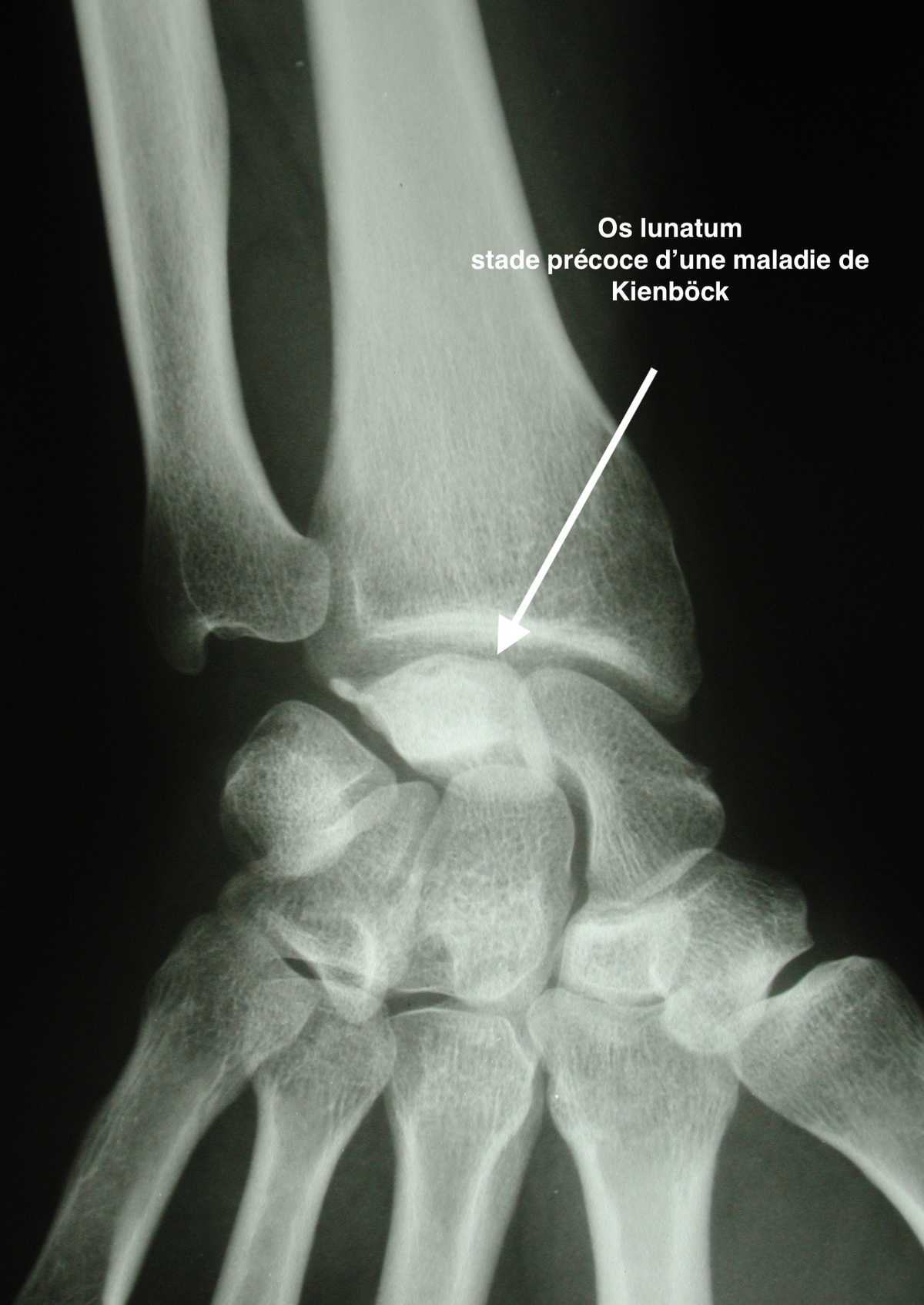
Early stages of Kienböck disease
In early stages where the lunate is not deformed or fragmented, the goal is to preserve the bone and promote revascularization and healing.
Possible procedures, depending on stage, patient profile, and surgeon preference, include radial shortening osteotomy or microsurgical revascularization of the lunate.
Radial shortening
Radial shortening is performed via an osteotomy, reducing pressure on the lunate and promoting revascularization, particularly in early stages or when the radius is naturally longer than the ulna.
A segment of the radius is removed, and the bone is fixed using a plate and screws. In a similar but less common procedure, the bone located beneath the lunate—the capitate bone—may also be shortened.
Microsurgical revascularization of the lunate
Microsurgical revascularization involves implanting blood vessels to restore blood supply to the lunate. This procedure may be performed through a dorsal incision or combined with wrist arthroscopy.
Advanced stages of Kienböck disease
In more advanced cases, the lunate is too damaged to be preserved and must be removed before it damages the surrounding wrist bones.
Several techniques may be considered: proximal row carpectomy, implant placement, and arthroscopy.
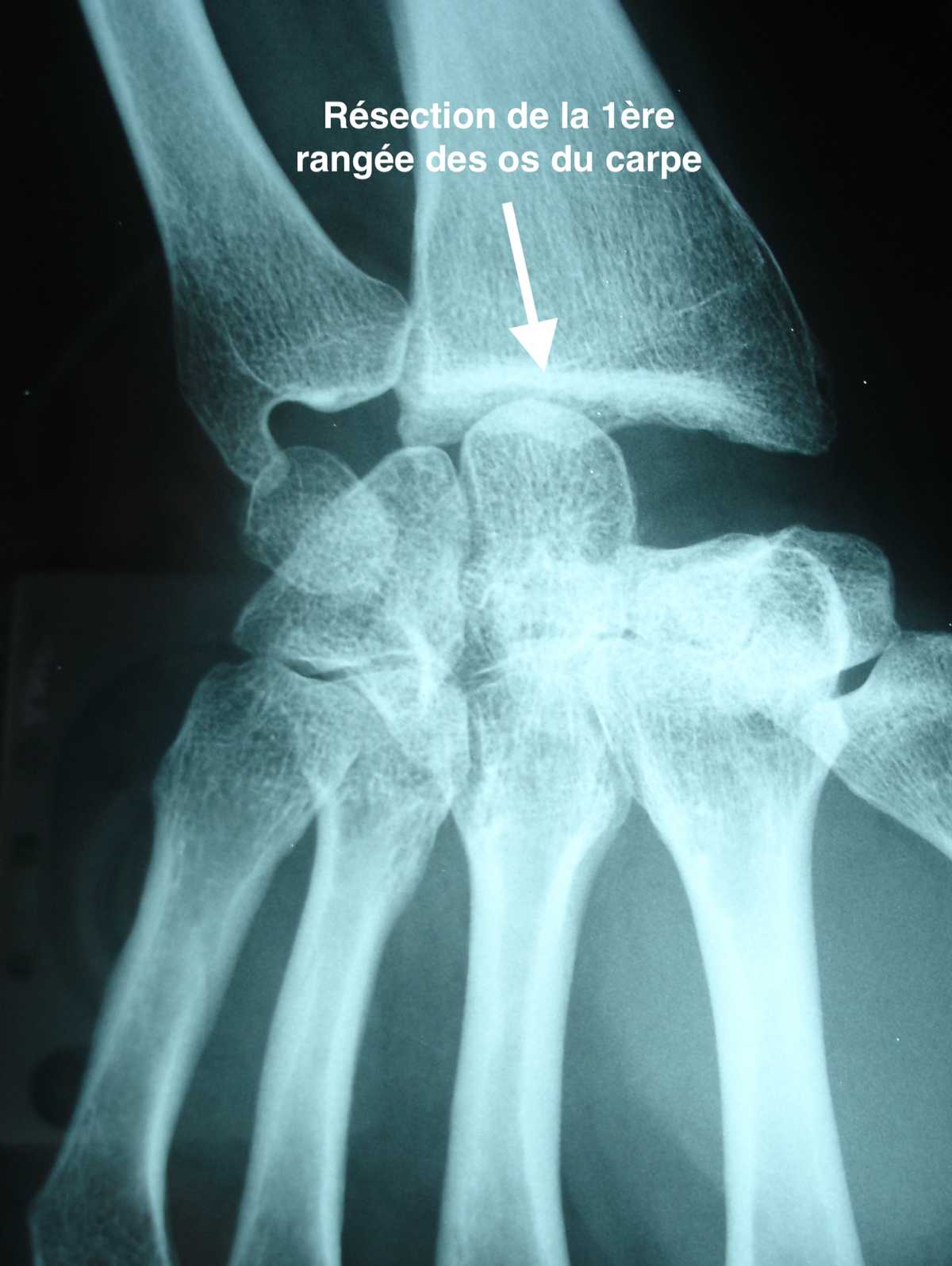
Proximal row carpectomy
Proximal row carpectomy involves removing the lunate as well as the two adjacent bones, the scaphoid and triquetrum.
The capitate bone then articulates directly with the radius.
When performed early enough, this procedure preserves a functional wrist and allows most daily activities to resume, with significant pain relief. However, it results in reduced wrist flexion and extension and sometimes decreased grip strength.
There are no cosmetic consequences to this procedure.
The placement of a pyrocarbon or silicone implant may sometimes be considered instead of the lunate.
Wrist arthroscopy
Wrist arthroscopy is a minimally invasive technique that, in some cases, allows removal of only the most damaged part of the lunate using small incisions and miniature instruments.
This technique is appealing and minimally disabling, but it is not always possible. During a preoperative consultation, the surgeon will determine whether it is appropriate for your case.
Most advanced stages
In the most advanced cases, where the necrotic lunate has damaged the other carpal bones and the radius, wrist arthrodesis is the best surgical option.
This procedure completely fuses the wrist bones using a plate and screws.
The wrist then loses all flexion and extension mobility. However, forearm rotation (pronation/supination), finger movement, and strength are preserved. Pain is significantly reduced or eliminated, and the wrist becomes stable and functional for daily and manual work activities.
Wrist denervation is another palliative procedure that may be considered when symptoms are tolerable despite bone damage.
This microsurgical procedure involves selectively cutting sensory nerve branches to the joint, reducing pain without affecting wrist mobility. However, the disease progression is not stopped.
Surgical procedure overview:
- Anesthesia: Regional
- Hospital stay: Outpatient or 1 night
- Immobilization: Arm in a sling for a few days, custom thermoplastic splint for 2–6 weeks depending on procedure, with immediate mobilization of the hand and elbow
- Rehabilitation: after immobilization, about 3 sessions per week until functional recovery
- Return to sports: between 2 weeks and 3 months depending on procedure and sport
Results after surgical treatment of Kienböck disease
It is important to remember that this is a relatively rare disease requiring specialist care.
Treatment decisions are closely linked to disease stage, impact on the patient’s life, and overall health profile.
Management is therefore decided on a case-by-case basis.
Without treatment, the natural progression leads to destruction of the lunate and then the wrist, causing pain and stiffness that severely limit hand and wrist function.
Available treatments generally help improve or stabilize the condition, preserving a functional wrist and hand, although some loss of motion and residual pain may persist depending on the procedure.
Possible complications
Complications after surgery for Kienböck disease are rare. However, postoperative recovery is often long. To achieve the best possible outcome, the patient must be motivated for surgery, immobilization, and rehabilitation.
Pain:
Pain may persist for several months after surgical treatment of Kienböck disease.
Risks:
Although rare and unpredictable, surgical procedures carry risks that must be weighed against the benefits.
Among the risks associated with Kienböck disease:
- Complex regional pain syndrome may occur, causing pain and stiffness in the hand and wrist, sometimes extending to the shoulder. Recovery is often long and may leave residual functional limitations.
- Septic arthritis is rare but possible. It may require additional surgery or medical treatment.
- Depending on skin type, inflammatory scarring may occur.