Synovial cyst of the wrist: Diagnosis and operation
A synovial cyst of the wrist is a swelling that appears as a ball filled with a gelatinous fluid, often located at the base of the wrist. Completely benign, this potentially unsightly cyst can cause significant aesthetic or functional discomfort. If it becomes chronic, surgical intervention is then recommended.

Contents:
Diagnosis of a synovial cyst
What is a wrist synovial cyst?
A wrist synovial cyst is a swelling that appears as a lump under the skin, filled with a gel-like fluid. It most commonly develops on the dorsal or volar side of the wrist. A synovial cyst may also appear on the fingers.
A synovial cyst (also called an arthro-synovial cyst) is completely benign, and its course is unpredictable. It may resolve spontaneously within the first few months or persist and become bothersome.
It can be particularly troublesome due to its cosmetic appearance. Because it is located on a socially visible area of the body, such as the wrist or hand, it may cause self-consciousness.
It may also lead to functional discomfort by compressing nearby structures (tendons, nerves, vessels), resulting in pain, reduced mobility, or decreased strength.
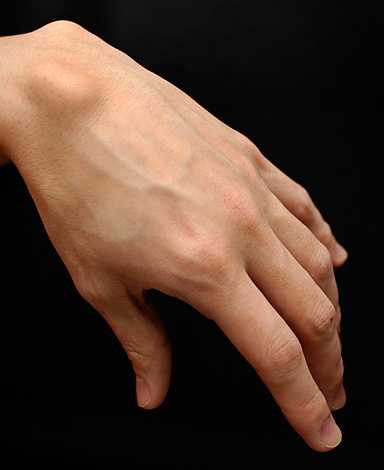
Is a synovial cyst painful?
Although usually not painful, a synovial cyst may sometimes cause local pain or referred pain into the hand or forearm.
Its onset may be sudden or gradual over several months, sometimes with intermittent symptom-free periods.
Small, even non-visible cysts can sometimes be the most painful, especially during forced wrist extension (e.g., push-ups), whereas large cysts may be completely painless.
Causes of a synovial cyst
Wrist synovial cysts are common. They most often affect young adults (20–40 years old), with no gender predominance. Children and elderly patients may also be affected.
They usually originate from the radiocarpal joint. They may occur spontaneously or following ligament injury between carpal bones, leading to irritation of the joint lining. The synovial membrane then distends and fills with synovial fluid, forming a cyst.
Trauma, repetitive movements, or micro-injuries may promote their development.
The size of the cyst often increases over several months, becoming visible and causing both aesthetic and functional discomfort.
At the finger level, these cysts often arise from the flexor tendon sheath.
Diagnosis of a synovial cyst
Diagnosis is made during a consultation. Additional imaging (MRI, CT scan) is usually not necessary, except sometimes ultrasound or standard X-rays.
If a more serious underlying condition is suspected, further imaging may be performed, especially in the wrist.
Treatment of a synovial cyst
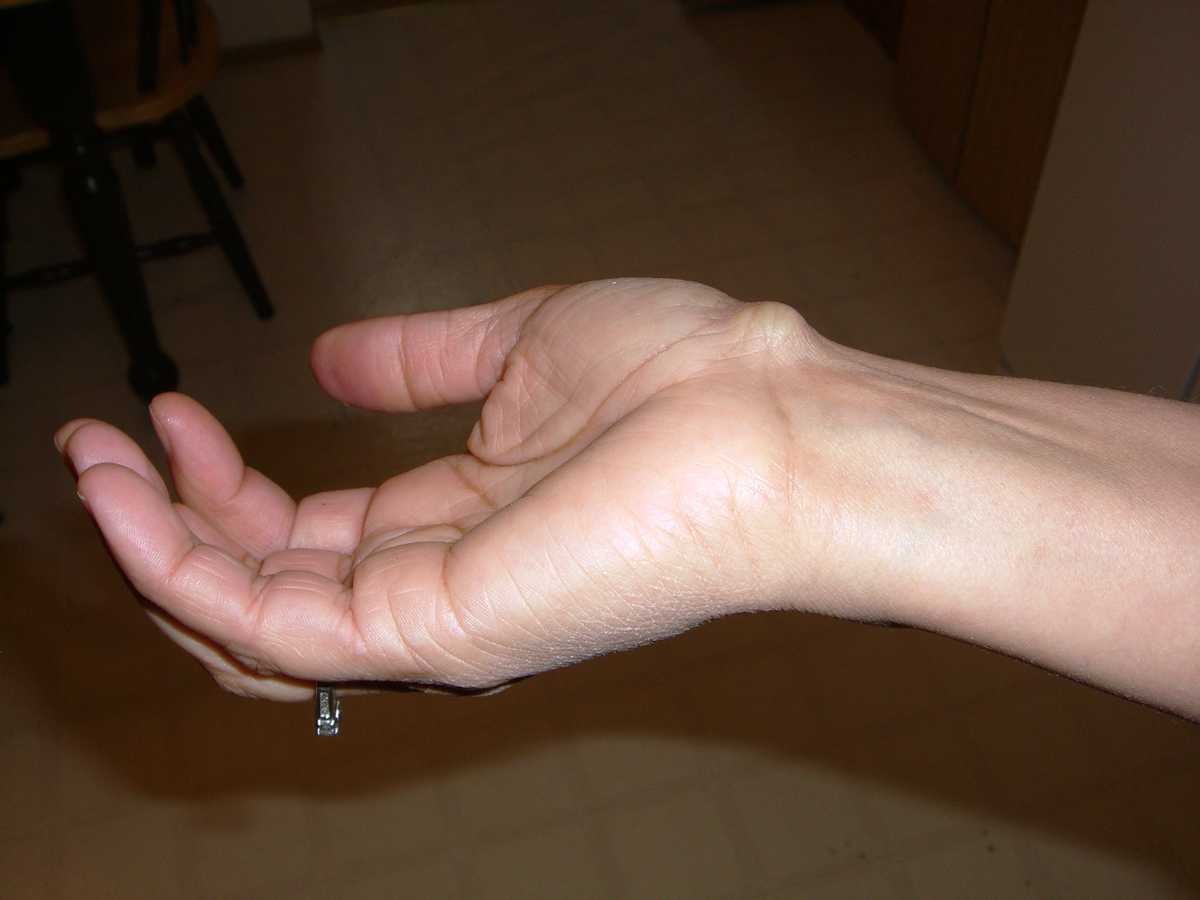
Can a synovial cyst be crushed?
Treatment is not always required. If the cyst is painless and well tolerated, it may be left untreated.
Some cysts disappear spontaneously within months and may recur later.
Crushing a synovial cyst is not recommended, as it is painful and often ineffective.
Aspiration treatment
Medical treatment consists of needle aspiration to drain the thick gelatinous fluid. Aspiration can be difficult due to the viscosity of the contents.
It may be combined with a corticosteroid injection to reduce recurrence risk.
However, the recurrence rate after aspiration remains high.
Surgical treatment of a synovial cyst
If the cyst is painful or causes functional or cosmetic discomfort, surgery may be proposed.
The procedure involves removal of the entire cyst, and treatment of any associated lesions to reduce recurrence risk.
Surgery may be performed arthroscopically or through a small open incision.
Surgical treatment of a wrist synovial cyst
Summary of the procedure:
- Duration: outpatient (no overnight stay)
- Anesthesia: regional
- A tourniquet is applied at the root of the limb to prevent bleeding
- Technique: arthroscopy or open surgery
Arthroscopic surgery
Arthroscopy is a minimally invasive technique using miniature instruments inserted through small incisions under camera guidance.
In wrist synovial cyst surgery, the procedure involves removal of the cyst from inside the joint, and treatment of any ligament lesions that could promote recurrence.
Compared with open surgery, arthroscopy offers two main advantages: a better cosmetic result due to smaller scars, and a faster functional recovery.
Open surgery
This is the traditional technique. It involves removing the cyst under magnification through a small incision, while preserving surrounding structures.
When arthroscopic access is not feasible, open surgery may be required.
Postoperative care after wrist synovial cyst surgery
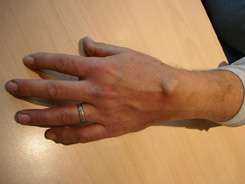
Immobilization and return to work after surgery
A wrist splint is worn for 10 to 15 days (fingers remain free).
Some physiotherapy sessions may be required afterward.
Return to work depends on the occupation. Sports involving wrist use can generally be resumed after 1 month.
Possible complications:
Complications are rare but must be considered:
- Recurrence (5–10%), sometimes requiring reoperation
- Temporary swelling of the wrist or finger for several weeks
- Small postoperative cysts at entry points (usually resolving spontaneously)
- Scar discomfort or unsightly scar in open surgery (smaller in arthroscopy)
- Infection (rare)
- Complex regional pain syndrome (CRPS / algodystrophy), causing swelling, stiffness, and pain over several months; outcome is unpredictable and may leave residual stiffness or pain