Arthroscopy of the wrist
Arthroscopy is a minimally invasive surgical technique using a camera and miniaturized instruments, resulting in a simple postoperative course and rapid recovery. This technique is indicated for treating severe wrist sprains, allowing for precise diagnosis and treatment of the injuries during the same surgical procedure..

Contents :
What is arthroscopy?
Arthroscopy is a surgical technique that involves operating on a joint using miniaturized instruments inserted through small incisions of a few millimeters, under the control of an endoscope connected to a video camera.
Thanks to arthroscopy, the surgeon can explore all anatomical structures inside the joint using a camera and a video screen. This technique allows for a precise diagnosis of various joint lesions and also enables treatment of a number of them.
It is a relatively recent technique, introduced in the early 1990s.
Indications for wrist arthroscopy
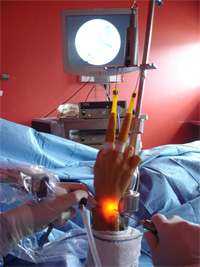
Arthroscopy for severe wrist sprains
Arthroscopic surgery is particularly indicated for treating severe wrist sprains. A severe sprain refers to cases where one or more ligaments connecting the wrist bones are torn.
Other indications for wrist arthroscopy
Diagnosing and treating wrist sprains are not the only indications for wrist arthroscopy. Other uses include:
- Precise treatment of articular fractures of the radius or the scaphoid
- Certain forms of early wrist osteoarthritis
- Removal of a synovial cyst
- Evaluation of chronic wrist pain not explained by standard imaging tests (X-ray, CT arthrogram)
Benefits of wrist arthroscopy
Arthroscopy has improved the understanding of previously unknown lesions. It also allows treatment of conditions that were not easily accessible with conventional open surgery.
Compared with traditional open surgery, arthroscopy offers simpler postoperative recovery and a faster return of wrist function. Pain is reduced, range of motion recovery is optimal, and scars are minimal.
Arthroscopy is useful for diagnosing and treating previously inaccessible lesions. In some cases, it can replace or delay open surgical techniques, which are much more invasive.
Wrist arthroscopy is reserved for experienced surgeons trained in the technique.
Principle of wrist arthroscopy
Summary:
- Goal of the procedure: Establish a diagnosis and treat a joint lesion during the same surgical procedure.
- Duration: outpatient (no overnight stay)
- Anesthesia: regional (only the arm is numbed)
- Scars: nearly invisible (2 to 4 millimeter incisions)
- Recovery: faster than open surgery
Procedure of wrist arthroscopy
During this wrist surgery, the wrist is held under vertical traction using a traction tower attached to the fingers.
Between 2 and 4 small incisions of a few millimeters are made on the back of the wrist. These allow insertion of the camera and instruments. The camera optics measure between 1.9 and 2.7 mm in diameter.
Several instruments may be used during wrist arthroscopy: hook probes, burrs, motorized shavers, thermal vaporizers, and miniaturized suture systems.
In addition to a precise exploration of cartilage, ligaments, and bone mobility, this technique allows treatment of many lesions. It is both a diagnostic and therapeutic procedure performed in the same operation.
Surgical procedures
During wrist arthroscopy, several procedures may be performed depending on the diagnosis:
- Ligament tears: unstable ligament fragments are removed. Stretched portions may be tightened using thermal shrinkage (micro-burn effect).
- Fractures or post-fracture sequelae: bone or cartilage fragments may be repositioned and precisely fixed.
- Osteoarthritis-related wear zones may be smoothed.
- Triangular fibrocartilage complex (TFCC) tears may be sutured under arthroscopic control.
- Scaphoid fractures may be fixed with screws or pins under perfect visual control.
- A synovial cyst may be completely removed from inside the joint.
Possible complications
Complications after wrist arthroscopy are rare but must be considered before surgery.
- In cases of significant intra-articular damage, arthroscopy does not always fully relieve pain and functional limitation.
- A small cyst may appear near the incision sites; it usually resolves within a few weeks.
- Tendon injuries, infection, or nerve irritation (small nerve branches) are rare but possible.
- Algodystrophy (complex regional pain syndrome) may occur, as with any surgery. It causes a swollen, painful, stiff wrist with a prolonged course over several months. It is unpredictable and may leave lasting stiffness or pain.