Mucous cysts of the fingers
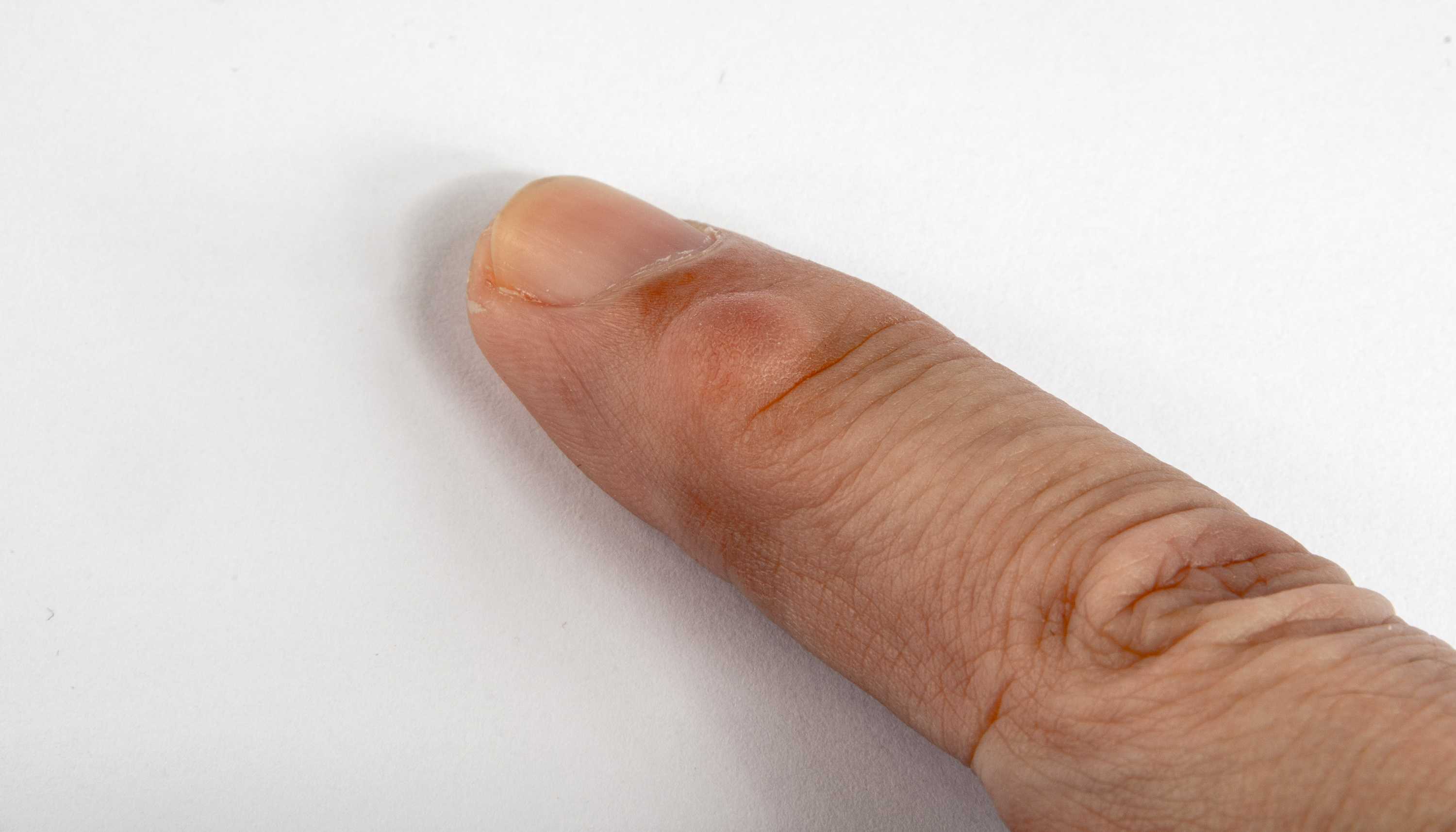
Mucous cyst is a tumefaction which appears at the extremity of the fingers, above the nail and develops either rapidly or progressively over several years. It is sometimes painful and often unsightly.
Summary :
What is a mucous cyst?
A mucous cyst is a synovial-type cyst (similar to a wrist cyst) arising from the last joint of the finger. It is generally caused by osteoarthritis affecting the last finger joint, known as the distal interphalangeal joint, often at an early stage.
A nail deformity (nail plate deformity) caused by compression of the nail matrix by the cyst may be observed.
A finger mucous cyst is benign, but complications may occur due to compression of surrounding finger structures, and especially because of the risk of infection, particularly joint infection, if the cyst ruptures.
Diagnosis
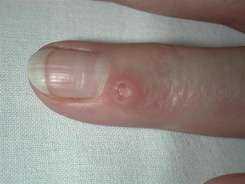
The diagnosis of a finger mucous cyst is made during the clinical examination in consultation.
The characteristic swelling of the mucous cyst is observed at the tip and on the back of the finger. This swelling may vary in size and is often particularly unsightly.
The cyst may be associated with a cup-shaped nail deformity caused by deep pressure on the nail matrix. This nail deformity may sometimes precede the appearance of the cyst.
Although the clinical examination is sufficient to diagnose the mucous cyst itself, an X-ray may be requested to assess the severity of the associated osteoarthritis.
A mucous cyst may rupture spontaneously or following trauma. A clear, gelatinous fluid then drains from the cyst. After this drainage, the cyst has not disappeared; it has simply collapsed and will usually reappear after a few days or weeks.
Inappropriate manipulation may therefore cause the cyst to rupture, potentially leading to an infection of the distal interphalangeal joint. It is therefore strongly recommended not to manipulate the cyst.
Treatment of a finger mucous cyst
In the case of a small or early-stage cyst
In the case of a small, painless cyst that does not cause nail deformity, specific treatment is not always necessary.
Non-surgical treatments are almost always ineffective and may lead to a risk of infection. These treatments include puncturing, aspiration or injections, the application of ointments, liquid nitrogen, dry ice, or laser treatments.
In the case of a large or well-established mucous cyst
When the mucous cyst becomes large or well established, the skin may become translucent. It may then rupture, potentially leading to joint infection. The nail may also become deformed because of deep compression of the matrix by the cyst.
In such cases, surgical excision is recommended.
Surgery may also be requested by patients bothered by the cyst’s particularly unsightly appearance. Indeed, the mucous cyst is highly visible to both the patient and others. It is located on the dorsal side of the hand, an area of the body that is constantly exposed to view, like the face.
Surgical procedure
Surgical excision of a finger mucous cyst is performed as an outpatient procedure (the patient goes home the same day). Regional anesthesia (only the arm is numbed) is generally used.
Principle of mucous cyst excision
The operation consists of completely removing the mucous cyst (the cyst itself and the osteophyte often present at its base) through a short incision.
Arthritic areas of the joint may be smoothed to reduce friction and therefore lower the risk of recurrence.
The overly thin skin over the cyst is removed. It may be replaced with a flap (skin taken from next to the operated area).
Postoperative care
A splint is applied to the last 2 phalanges of the finger for approximately 10 days after surgery.
The hand can be used for daily activities starting the day after surgery, while naturally avoiding pressure on the operated finger.
The dressing must be changed every 2 days by a nurse.
The operation generally causes no pain, although some discomfort from the dressing may be felt.
Sick leave may be prescribed depending on the patient’s professional activity.
Summary
- Hospitalization type : Outpatient surgery
- Procedure duration: 30 minutes
- Anesthesia : Regional
- Recovery : Wearing a splint on the last phalanges of the operated finger for 10 days.
Possible complications
Complications following mucous cyst surgery are rare, but should be considered as with any surgical procedure (see surgical risks).
- The most common complication is delayed wound healing. Additional nursing care for several days or weeks may then be required.
- Infection is always possible, although uncommon.
- Recurrence remains possible (5 to 10% of cases). Another procedure may then be performed.
- A moderate loss of mobility of the last joint may rarely be observed.
- Complex regional pain syndrome (CRPS) may occur, as with any surgical procedure, resulting in a swollen, painful, and stiff hand, with symptoms potentially lasting several months. Its occurrence is unpredictable, and long-term stiffness and pain may persist.