Carpal tunnel syndrome: diagnosis and surgery
The symptoms experienced during carpal tunnel syndrome are characterized by numbness and tingling in the fingers. This syndrome can initially be treated with medication, but generally requires surgery, which can be performed endoscopically.

Summary :
Diagnosis of carpal tunnel syndrome
What is the carpal tunnel?
The median nerve is a nerve that travels from the root of the arm to the hand, passing through the elbow, forearm, and wrist. It divides into sensory branches (which provide sensation to the fingers) and a motor branch (which controls the muscles at the base of the thumb).
The median nerve enters the hand through the carpal tunnel, located at the wrist. This tunnel, formed by a bony groove, is closed at the front by a strong ligament called the retinaculum. The flexor tendons and the median nerve pass through this tunnel.
Carpal tunnel syndrome refers to the compression of the median nerve as it passes through this tunnel.
Symptoms of carpal tunnel syndrome
Carpal tunnel syndrome causes numbness in the first four fingers (thumb, index, middle, and ring fingers) and chronic unpleasant sensations in the fingers.
Patients experience tingling and burning sensations. These symptoms are often more frequent at night or upon waking (the fingers feel stiff or “frozen”). This may be associated with pain in the hand that often radiates to the forearm, elbow, or even the shoulder.
As the condition progresses, clumsiness and loss of sensation may develop. In some cases, there may even be a loss of thumb mobility associated with muscle wasting (atrophy).
How is carpal tunnel syndrome diagnosed?
To confirm the diagnosis, an electromyogram (EMG) is performed. This test records the electrical current carried by the nerve. The electromyogram determines the severity of the nerve damage and the site of compression. It may also reveal associated involvement of the ulnar nerve (which provides sensation to the 4th and 5th fingers).
An X-ray of the wrist and hand is not always necessary.
Consequences without treatment
Without treatment for carpal tunnel syndrome, the nerve progressively loses its function. A permanent loss of sensation in the fingers may develop (dropping objects, inability to pick up small objects). Certain thumb movements may become impossible, especially fine motor tasks such as picking up a coin.
This syndrome is frequently associated with trigger finger.
Treatment of carpal tunnel syndrome
Treatment for carpal tunnel syndrome is mainly surgical, although medical treatment may initially be proposed in early cases. The choice of treatment depends on the severity of compression, symptom intensity, and the results of the electrical examination.
Medical treatment with injections and splinting
Treatment of carpal tunnel syndrome is often initially medical in early cases. It consists of wearing a night resting splint for the wrist.
One or more corticosteroid injections may also be proposed if symptoms persist. The aim of these injections is to reduce swelling inside the carpal tunnel by decreasing synovitis. This is a symptomatic treatment that may provide temporary relief but does not cure the compression causing the syndrome. These injections should not be repeated excessively (maximum of 1 or 2 injections).
If medical treatment is ineffective, surgical treatment should be considered. Surgery is also proposed immediately when the electromyogram shows severe involvement of the median nerve (with significant sensory loss).
Surgical treatment of carpal tunnel syndrome
Carpal tunnel surgery consists of opening the tunnel by cutting the transverse carpal ligament, known as the retinaculum. Opening the tunnel increases its volume and restores normal median nerve function by decompressing it. The numbness disappears and finger sensation gradually improves.
Open surgery or endoscopic surgery for carpal tunnel syndrome?
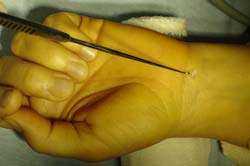
Two techniques can be used to perform this operation.
The “open” technique is the conventional approach involving an incision in the palm of the hand (and therefore a scar). The procedure is most often performed under regional anesthesia, sometimes combined with sedation.
The endoscopic technique is a minimally invasive surgery performed using a camera and miniature instruments. It requires a small incision (8 to 10 mm) in the wrist crease. The endoscopic technique has two major advantages over the conventional method: postoperative pain is reduced and recovery of hand function is faster.
Dr. Philippe Roure favors the endoscopic technique for carpal tunnel operations performed at the Clinique du Sport (Paris 5th district).
Endoscopic carpal tunnel surgery procedure
Summary:
- Hospitalization: Outpatient surgery (no overnight stay)
- Anesthesia: Regional anesthesia (only the arm is numbed). A tourniquet is placed at the base of the limb to stop blood flow.
- No immobilization
- Return to daily hand activities: 48 hours.
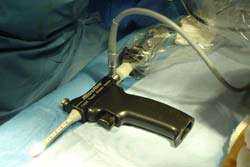
The surgical procedure
The endoscopic operation first involves making an 8 to 10 mm incision in the wrist flexion crease. Through this incision, a miniature system containing a camera and a retractable blade is introduced.
After exposing the nerve and tendons, the surgeon cuts the transverse carpal ligament under camera guidance.
The edges of the ligament separate, thereby increasing the diameter of the carpal tunnel. The median nerve then regains the space it needs to function properly.
End of the procedure
The skin is closed using absorbable sutures. The scar is protected with adhesive strips.
Patients usually leave the clinic a few hours after surgery (outpatient hospitalization). A full-day hospitalization may be required depending on the patient’s condition, family or geographic situation (for example, if the patient does not live in Paris or the surrounding region), or if postoperative circumstances require it.
Recovery and results after carpal tunnel surgery
Healing is generally achieved within approximately two weeks after surgery.
Rehabilitation is self-managed; physiotherapy is not required.
The time needed before returning to work depends on the type of occupation and the movements involved. In general, 3 to 30 days of recovery should be expected.
Daily activities, such as driving, are usually possible from the third postoperative day.
Pain in the palm of the hand during pressure or twisting movements (opening a bottle, wringing a mop, shifting a car into reverse gear, etc.) is common and normal. It results from ligament division and tissue healing and may last on average up to 6 months after surgery.
Muscle strength initially decreases after surgery before returning over the following months. Some movements may remain painful for a period of time, on average up to 6 months.
In most cases, the numbness disappears rapidly after surgery. However, the loss of sensation may improve more slowly or may not fully recover if surgery was performed at too advanced a stage.
Possible complications after carpal tunnel surgery
Carpal tunnel decompression surgery has proven effective and reliable. Nevertheless, no surgical procedure is entirely free of complications:
- Postoperative infection is exceptional and can usually be managed easily when diagnosed early. It presents with abnormal throbbing pain, swelling, and redness.
- A sensation of tingling in the fingers may occur. It usually disappears within a few months.
- The risk of complex regional pain syndrome (CRPS) is rare but must be considered. CRPS presents with a swollen, painful hand associated with sweating and later stiffness. Recovery is prolonged over several months or even years. Permanent sequelae are possible (residual pain, some stiffness of the fingers and/or wrist, and sometimes even the shoulder).
- Nerve injuries are exceptional.
- A nerve laceration is possible. Additional surgery is then required.
- Recurrence is uncommon but can never be completely ruled out. Revision surgery remains possible.